
Massenet Meditation Violin Sheet Music PDF: A Comprehensive Guide
This guide explores accessing Massenet’s “Meditation” sheet music in PDF format, detailing online resources like 8notes.com and Free-Scores.com for violinists.
What is Massenet’s Meditation from Thaïs?
Massenet’s “Meditation” is a celebrated orchestral interlude originating from his four-act opera, Thaïs, first performed in 1894. It’s not part of the vocal score, but rather a purely instrumental piece positioned between the second and third acts. This exquisite melody is renowned for its lyrical beauty and emotional depth, quickly gaining independent popularity, especially in arrangements for solo violin and piano.
Originally conceived to musically represent a serene and contemplative scene, the “Meditation” has become a staple in the violin repertoire. Its captivating melody lends itself beautifully to the instrument’s expressive capabilities, allowing violinists to showcase their technical skill and musicality. Numerous free sheet music options in PDF format are readily available online, making this piece accessible to musicians of varying levels.
Historical Context of Thaïs Opera
Jules Massenet’s Thaïs premiered at the Opéra-Comique in Paris in 1894, quickly becoming a popular work despite initial critical reservations. The opera’s narrative, based on Anatole France’s novel, centers on Thaïs, a beautiful Egyptian courtesan, and Saint Athanaël, a monk determined to convert her. The story explores themes of religious devotion, temptation, and redemption within the historical backdrop of Roman Egypt.
The “Meditation” emerges within this dramatic context, serving as a musical interlude depicting Thaïs’s former life of luxury and sensuality. Understanding this origin enriches the appreciation of the piece, even when experienced as a standalone violin and piano arrangement. The availability of free PDF sheet music allows modern musicians to connect with this historical and artistic legacy.
The Violin Solo’s Significance
Massenet’s “Meditation” is renowned for its exquisite violin solo, arguably the opera’s most famous excerpt. Originally conceived as orchestral music accompanying a scene change, its lyrical beauty quickly elevated it to a standalone piece for violin and piano. The solo encapsulates Thaïs’s allure and vulnerability, expressing a poignant blend of longing and sensuality.
The availability of PDF sheet music has cemented its place in the violin repertoire, offering musicians of all levels the opportunity to interpret this iconic melody. Its technical demands, while accessible, require expressive phrasing and a refined vibrato. Finding free, reliable PDF versions allows widespread access to this cornerstone of romantic violin literature.
Finding Free Sheet Music Online
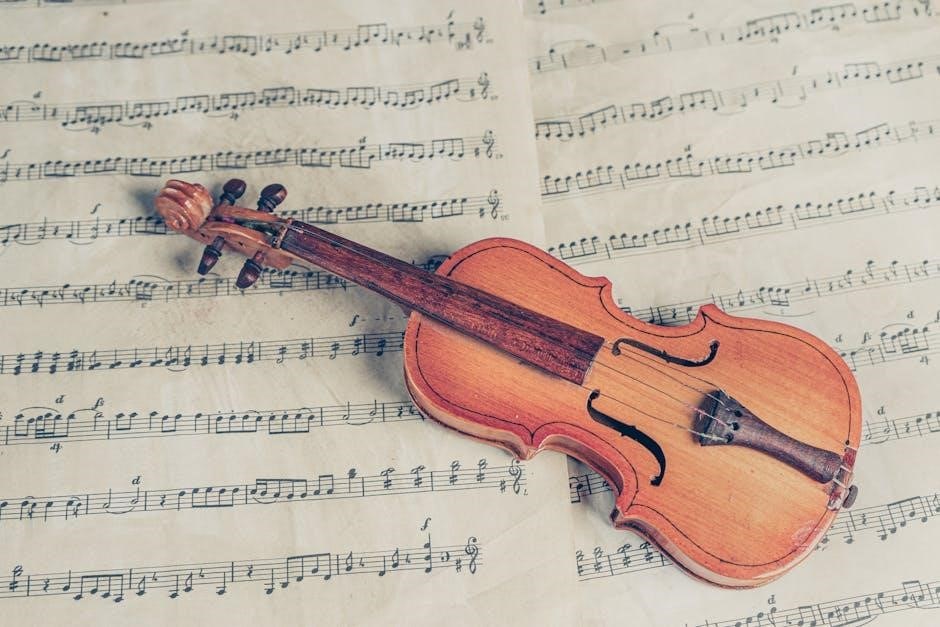
Numerous websites offer free “Meditation from Thaïs” sheet music in PDF format, including 8notes.com, Free-Scores.com, and the IMSLP/Petrucci Music Library for violinists.
Popular Websites for Free Downloads (8notes.com)
8notes.com stands out as a readily accessible platform for violinists seeking Massenet’s “Meditation” sheet music. The website provides a free PDF download of the piece, specifically arranged for violin. Users can easily view and download the score directly from their website, making it a convenient option for quick access.
While the quality may vary compared to professionally purchased sheet music, 8notes.com offers a valuable resource for practice and learning. The site also features user ratings and comments, providing insights into the accuracy and playability of the arrangement. It’s a great starting point for those exploring this beautiful piece and needing immediate access to a free, downloadable PDF version.
However, always double-check the arrangement against other sources to ensure accuracy and musical integrity.
Free-Scores.com: A Resource Overview
Free-Scores.com presents a comprehensive catalog of sheet music, including various arrangements of Jules Massenet’s “Meditation” from Thaïs. The site offers both free and premium options, with the free version providing access to a basic PDF of the violin solo. Users can filter searches by composer, instrumentation, and genre to quickly locate the desired score.
The platform distinguishes between free and premium scores, with the latter often offering higher quality and more accurate transcriptions. Free-Scores.com also details copyright information and arranger credits, ensuring transparency for users. It’s a valuable resource for violinists seeking multiple versions of the piece, allowing comparison and selection based on individual needs and skill level.
Remember to review the licensing terms before using any downloaded material.
IMSLP/Petrucci Music Library Access
IMSLP (International Music Score Library Project), also known as the Petrucci Music Library, is a vital resource for public domain sheet music. Several editions of Massenet’s “Meditation” from Thaïs are available for violin, often including versions for violin and piano. Access is generally free, requiring only a user account for downloading.
The library boasts a wide range of transcriptions and arrangements, allowing violinists to explore different interpretations of the piece. IMSLP’s catalog is meticulously organized, with detailed information about each score’s origin and editor. Users can preview scores online before downloading the PDF format.
Always verify the score’s accuracy and completeness, as editions may vary in quality. It’s a cornerstone for classical music resources.

Sheet Music Formats: PDF vs. MIDI
PDFs offer visual accuracy for sheet music, while MIDI files provide a playable, editable format, though conversion between the two is often necessary.
Understanding PDF Sheet Music
PDF (Portable Document Format) sheet music for Massenet’s “Meditation” provides a visually accurate representation of the original score, preserving notation details crucial for performance. Downloading PDFs ensures consistent formatting across devices, making it ideal for printing and viewing on various screens.
These files typically contain scanned images or digitally created notation, offering a faithful reproduction of the composer’s intent. Free resources like 8notes.com and Free-Scores.com offer downloadable PDFs, though quality can vary.
PDFs are static, meaning you can’t easily edit notes or change instrumentation. However, they are universally compatible and maintain the aesthetic qualities of the printed score, essential for studying and performing this beautiful violin piece. Carefully review the source before downloading to ensure accuracy.
MIDI Files: Advantages and Disadvantages
MIDI (Musical Instrument Digital Interface) files for Massenet’s “Meditation” offer a different approach compared to PDF sheet music. A key advantage is their editability; you can adjust tempo, transpose keys, and even isolate the violin part for focused practice. They are also significantly smaller in file size, facilitating easy sharing and storage.
However, MIDI files lack the visual clarity of a traditional score. They require a MIDI player or software to be audible and don’t display notation directly.
Furthermore, the sound quality depends heavily on the soundfont used, potentially deviating from the intended timbre. While useful for learning the notes, MIDI doesn’t fully capture the nuances of Massenet’s expressive writing, making PDFs preferable for accurate interpretation.
Converting MIDI to PDF
Converting a MIDI file of Massenet’s “Meditation” to PDF can bridge the gap between editability and visual notation, though results vary. Several software options facilitate this process, including MuseScore, Sibelius, and Finale. These programs import the MIDI data and render it as standard musical notation.
However, automatic conversion isn’t always perfect. The software may misinterpret phrasing, dynamics, or articulation, requiring manual correction. The resulting PDF might not precisely match a professionally engraved score.
Despite these limitations, conversion can be useful for creating a printable version of a modified MIDI file or for generating a basic score from a freely available MIDI version of the piece. Careful review and editing are crucial for accuracy.
Variations and Arrangements
Numerous arrangements of Massenet’s “Meditation” exist, including versions for violin and piano, concert organ, accordion ensembles, and even timpani, offering diverse interpretations.
Violin and Piano Arrangement
The most prevalent arrangement of Massenet’s “Meditation” is undoubtedly for violin and piano. This version beautifully captures the lyrical essence of the original orchestral piece, translating it into an intimate and accessible format for performers.
Sheet music for this arrangement is widely available online, often found as free PDF downloads on sites like 8notes.com and through resources listed on IMSLP/Petrucci Music Library. Marsick’s arrangement is particularly popular, offering a well-regarded transcription.
The piano accompaniment provides a rich harmonic foundation, supporting the expressive violin melody. This arrangement is frequently used by students and professional violinists alike, making it a cornerstone of the repertoire. Finding a quality PDF ensures accurate notation for a successful performance.
Concert Organ & Violin Transcription
A less common, yet captivating, arrangement of Massenet’s “Meditation” exists for concert organ and violin. This transcription offers a unique sonic palette, leveraging the organ’s powerful and sustained tones to create a dramatic and evocative atmosphere.
Finding sheet music for this specific pairing requires a more focused search, as it’s not as universally available as the violin and piano version. Resources like Free-Scores.com sometimes feature transcriptions for unusual instrumentations.
The organ part often mimics the orchestral textures, providing a full and resonant backdrop for the violin’s soaring melody. This arrangement is favored for its grandeur and is often performed in larger venues, showcasing the organ’s capabilities alongside the violin’s expressiveness.
Arrangements for Accordion and Timpani
Surprisingly, arrangements of Massenet’s “Meditation” exist for the unusual combination of accordion and timpani. These transcriptions demonstrate the piece’s adaptability and the creativity of arrangers seeking novel interpretations. The accordion, with its expressive bellows and tonal range, can surprisingly emulate the lyrical qualities of the violin.
The timpani provides a rhythmic and dramatic foundation, adding depth and resonance to the melody. Locating sheet music for this instrumentation is challenging, often requiring specialized music libraries or online searches focused on less conventional arrangements.
These versions are often utilized for unique performances or educational purposes, showcasing the versatility of both instruments and offering a fresh perspective on a beloved classic.

Difficulty Level and Skill Requirements
“Meditation” demands significant violin technique, requiring an intermediate to advanced player with strong intonation, vibrato, and expressive phrasing capabilities.
Beginner Considerations
For beginner violinists, tackling Massenet’s “Meditation” directly presents substantial challenges. The piece isn’t ideally suited for those early in their learning journey due to its technical demands. However, aspiring players can utilize simplified arrangements or excerpts to build foundational skills.
Focusing on smaller sections, particularly melodic phrases, can be beneficial. Prioritize mastering basic bowing techniques and accurate finger placement before attempting the full piece. Consider working with a qualified instructor who can provide guidance and adapt the music to a more manageable level.
Beginners should also be aware of the piece’s expressive nature, which requires a developed sense of musicality. While the full composition may be beyond reach initially, exploring it gradually can inspire and motivate continued practice.
Intermediate Player Challenges
Intermediate violinists approaching Massenet’s “Meditation” will encounter challenges beyond basic technique. Maintaining consistent tone quality throughout the lyrical phrases requires refined bowing control and a developed vibrato. Accurate intonation is crucial, particularly in the higher registers, demanding precise finger placement and ear training.
The piece’s expressive demands also present a hurdle; conveying the emotional depth requires musical maturity and sensitivity. Players must navigate subtle dynamic shifts and phrasing nuances.
Furthermore, mastering the legato style, essential for this composition, necessitates seamless transitions between notes. Addressing these challenges through focused practice and guidance from an instructor will unlock the piece’s beauty.
Advanced Techniques Required
“Massenet’s Meditation” demands a sophisticated skillset from advanced violinists. Beyond impeccable intonation and vibrato, nuanced bowing techniques – including spiccato and sautillé – enhance the piece’s delicate character. Mastery of portamento, subtle slides between notes, is vital for expressive phrasing.
Complex finger patterns and extended range require exceptional left-hand dexterity. Players must demonstrate control over dynamics, achieving a wide spectrum from the most delicate pianissimo to resonant mezzo forte.
Furthermore, a deep understanding of musical interpretation and stylistic nuance is essential to convey the opera’s emotional core. Achieving a polished performance necessitates dedicated practice and artistic maturity.

Tips for Learning the Piece
Begin with slow practice, prioritizing accurate intonation and a consistent tempo. Develop a rich vibrato and focus on expressive phrasing for success.
Slow Practice and Tempo Control
Mastering Massenet’s “Meditation” demands deliberate, slow practice. Initially, prioritize accuracy over speed; this builds a solid foundation. Utilize a metronome to establish consistent tempo, gradually increasing it only when comfortable. Break down challenging passages into smaller sections, repeating them until flawless.
Focus on even bow distribution and clear articulation at slower tempos. Resist the urge to rush; patience is key. Regularly check intonation, ensuring each note is precisely in tune.
Tempo control isn’t merely about speed, but about musicality. Experiment with subtle variations in tempo to enhance expression. Record yourself playing and critically evaluate your performance, identifying areas for improvement. Slow practice unlocks the piece’s lyrical beauty.
Focusing on Intonation
Precise intonation is paramount when performing Massenet’s “Meditation.” The piece’s lyrical quality is severely compromised by even slight inaccuracies. Utilize a tuner regularly during practice to verify pitch, especially on sustained notes and during shifts.
Develop a keen ear by playing along with a drone or piano accompaniment. Pay close attention to intervals and harmonic relationships; Practice scales and arpeggios in the relevant key to reinforce fingerboard knowledge.
Slow practice allows for meticulous intonation checks. Record yourself and listen critically, identifying any pitch discrepancies. Consistent, focused practice will cultivate the ear and muscle memory needed for flawless intonation.
Developing Vibrato Technique
A beautiful vibrato is crucial for conveying the emotional depth of Massenet’s “Meditation.” Begin by mastering a relaxed wrist motion, ensuring it’s fluid and natural, not forced or tense. Practice slow, controlled vibrato on open strings, gradually increasing speed and intensity;
Experiment with different vibrato widths and speeds to discover what best suits the piece’s expressive character. Focus on consistency and evenness throughout the vibrato.
Apply vibrato selectively, emphasizing expressive phrases and sustained notes. Avoid overuse, as it can sound artificial. Regular practice and mindful listening will refine your vibrato technique, enhancing the piece’s lyrical beauty.

Copyright and Legal Considerations
Massenet’s “Meditation” is generally in the public domain, allowing free access to sheet music. However, specific arrangements may have copyright restrictions.
Public Domain Status
Jules Massenet passed away in 1912, placing his compositions, including the celebrated “Meditation from Thaïs,” firmly within the public domain globally. This means the original sheet music is free from copyright restrictions, allowing for unrestricted access, download, and performance.
Consequently, numerous websites offer free PDF versions of the score. However, it’s crucial to remember that while the original composition is public domain, specific arrangements or transcriptions – such as those for concert organ or accordion – may still be protected by copyright. Always verify the licensing terms for any modified versions before use. This ensures respect for the arranger’s intellectual property rights, even when the underlying melody is freely available.
Understanding public domain status empowers violinists to explore and share this beautiful piece without legal concerns regarding the core composition.
Licensing and Usage Rights
While Massenet’s “Meditation” itself is in the public domain, specific sheet music editions and arrangements may carry licensing restrictions. Websites offering free PDF downloads often have their own terms of use, typically permitting personal, non-commercial enjoyment.
Commercial use – such as performing the piece for profit, creating derivative works for sale, or including it in a commercial recording – may require obtaining licenses or permissions from the source providing the specific arrangement. Always check the website’s licensing information before utilizing the sheet music for any income-generating activity;
Respecting these rights ensures ethical music practice and supports the continued creation of musical resources for violinists. Proper attribution to the arranger is also good practice, even with public domain material.
Respecting Composer’s Rights
Although Jules Massenet’s original composition of “Meditation” from Thaïs is now in the public domain, acknowledging the composer’s artistry remains crucial. Utilizing free sheet music PDF versions doesn’t diminish the importance of recognizing Massenet’s creative contribution to the world of music.
When performing or studying the piece, understanding its historical context and the composer’s intent enhances appreciation. Supporting living composers and arrangers by purchasing their work, when applicable, upholds the value of musical creation.
Even with public domain works, ethical practice involves respecting the artistic integrity of the original composition and any subsequent arrangements found as free sheet music.

Resources for Violinists
Violinists can find online tutorials, sheet music editing software, and active forums to aid learning Massenet’s “Meditation” from PDF sheet music.
Online Tutorials and Lessons
Numerous online platforms offer tutorials specifically for learning Massenet’s “Meditation.” YouTube hosts a wealth of free lessons, ranging from beginner-friendly introductions to advanced technique breakdowns. Search for “Massenet Meditation violin tutorial” to discover performances with guided instruction, focusing on phrasing and intonation.
Websites like ViolinMasterclass.com and others provide structured courses, often with downloadable practice materials alongside the PDF sheet music. These lessons frequently dissect challenging passages, offering fingering suggestions and bow stroke guidance. Consider exploring platforms offering live, interactive sessions with experienced violin instructors for personalized feedback. Utilizing these resources alongside your PDF sheet music will accelerate your progress and refine your interpretation of this beautiful piece.
Sheet Music Editing Software
For violinists working with Massenet’s “Meditation” PDF sheet music, editing software can be invaluable. Programs like MuseScore (free and open-source) and Sibelius allow for customization – adjusting tempo markings, adding fingerings, or even transposing the piece. These tools are particularly useful if you download a PDF that’s poorly formatted or lacks specific annotations.
Software like Finale offers advanced features for detailed editing and arrangement. You can create custom practice tracks, isolate specific sections, or experiment with different bowings directly on the digital score. While a basic PDF reader is sufficient for viewing, editing software empowers you to personalize the sheet music to suit your individual learning style and technical needs, enhancing your practice experience.
Violin Forums and Communities
Engaging with online violin forums and communities provides a valuable resource when studying Massenet’s “Meditation” from PDF sheet music. Platforms like Violinist.com and dedicated Facebook groups offer spaces to discuss interpretations, share fingerings, and troubleshoot challenging passages.
Experienced violinists often share their insights on bowing techniques and vibrato application specific to this piece. You can also find discussions about different editions of the sheet music, comparing their accuracy and usability. These communities are excellent for seeking advice, receiving feedback on your playing, and connecting with fellow musicians tackling the same repertoire, enriching your learning journey.

Exploring Other Massenet Works
Jules Massenet composed numerous operas and orchestral pieces; discovering these expands your musical horizons beyond the famous “Meditation” violin solo.
Brief Overview of Massenet’s Compositions
Jules Massenet (1842-1912) was a prolific French composer, primarily known for his operas. He blended dramatic flair with lyrical melodies, creating a distinctly Romantic style. While “Thaïs” and its “Meditation” are his most recognizable works, Massenet’s output extends far beyond this single piece.
He composed over thirty operas, including “Manon,” “Werther,” and “Esclarmonde,” each showcasing his talent for vocal writing and dramatic storytelling. Beyond opera, Massenet also wrote ballets, orchestral works, and songs. His compositions often feature beautiful, expressive melodies and a refined sense of orchestration.
Massenet’s music reflects the influence of his contemporaries, such as Wagner and Verdi, but he developed a unique voice that continues to resonate with audiences today. Exploring his broader catalog reveals a composer of considerable depth and artistry, offering a rich tapestry of musical experiences.
Similar Pieces for Violin
Violinists captivated by Massenet’s “Meditation” often appreciate pieces sharing its lyrical beauty and expressive qualities. Saint-Saëns’ “Romance” for Violin and Orchestra offers a similar blend of Romantic melody and technical accessibility. Chausson’s “Poème” is another excellent choice, demanding greater virtuosity but rewarding with its passionate intensity.
For those seeking a slightly different flavor, Bruch’s “Kol Nidrei” provides a deeply emotional experience, though rooted in Jewish liturgical music. Wieniawski’s “Légende” showcases dazzling technique alongside heartfelt expression;
Exploring these works expands a violinist’s repertoire and provides opportunities to develop similar stylistic nuances found in Massenet’s masterpiece. Each piece offers unique challenges and rewards, enriching the musical journey.
Influence on Later Composers
Jules Massenet’s melodic gift and dramatic flair, evident in “Thaïs” and its celebrated “Meditation,” profoundly impacted subsequent composers. His emphasis on beautiful, vocal-like lines in instrumental writing resonated with composers like Gabriel Fauré, who shared a similar sensitivity to harmonic color and lyrical expression.
The piece’s emotional depth and evocative atmosphere also influenced film composers, who frequently draw upon Romantic-era orchestral techniques to create compelling scores. Massenet’s ability to blend technical brilliance with heartfelt emotion continues to inspire musicians today.
His work helped pave the way for a more expressive and emotionally resonant style in late Romantic and early 20th-century music.